Ramesthi: A Modern Handwritten Font for Crafters & Sellers
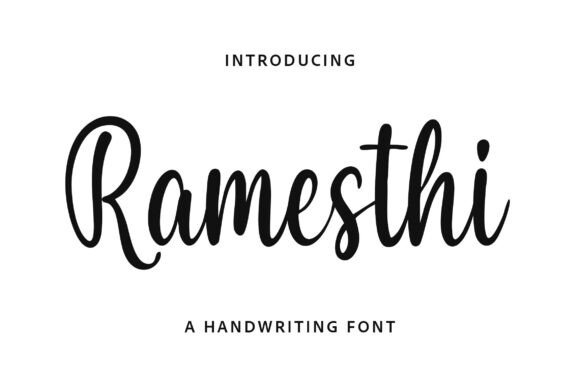
If you've ever spent hours tweaking letter spacing on a candle label, second-guessing whether your wedding welcome sign feels warm but still legible, or wondered why your printable planner pages don’t quite *sing*—you’re not alone. As a maker who designs physical products and digital downloads daily, I know how much weight the right font carries. That’s why Ramesthi has become my go-to modern handwriting typeface—not for its flashiness, but for its quiet confidence. It’s elegant without being fussy, upright and grounded yet full of natural flow, and designed to look handmade without sacrificing clarity.
Ramesthi lives in the Script Amp category, which means it’s built for impact: expressive enough for display use, refined enough for boutique branding, and versatile enough to scale from a 6pt tag to a 24-inch wall quote. Its characters stand tall and graceful—no exaggerated slant or forced flourish—so names, titles, and short phrases read cleanly even at smaller sizes. That upright posture is a quiet superpower: it holds up beautifully on Cricut and Silhouette mats, cuts crisply on vinyl, and stays legible when printed on kraft paper tags or matte sticker sheets.
I’ve used Ramesthi across dozens of real product types—and each time, it reinforced why this isn’t just another script font. On candle labels, it gives soy wax brands an artisanal warmth that customers associate with care and craftsmanship. For wedding stationery, it adds sophistication to “Mr. & Mrs.” on foil-stamped invitations without competing with delicate floral motifs. On farmhouse-style signs, it grounds rustic wood with soft authority—think “Gather Here” or “Welcome Home” cut from birch plywood. And for digital printables, like monthly planner headers or gratitude journal prompts, Ramesthi balances personality with readability so users actually *enjoy* writing in those spaces.
What makes Ramesthi especially practical for sellers is how well it performs where other scripts falter. Unlike loopy, low-contrast handwriting fonts, Ramesthi maintains generous x-height and open counters—those little gaps inside letters like ‘a’, ‘e’, and ‘o’. That means it stays clear on small product tags (like tea bag labels or mini soap wraps), reads well in mockup previews on Etsy listings, and avoids the dreaded “blurred edge” when scaled down for social media graphics or Instagram story templates.
It shines brightest in short-form applications: shop names on tote bags, seasonal greetings on holiday mugs, monograms on embroidered patches, or “Hand-Poured” callouts on skincare packaging. While Ramesthi isn’t intended for body text or long paragraphs, its design supports thoughtful emphasis—pairing perfectly with clean sans serif fonts like Montserrat or Inter for contrast, or grounding itself alongside a subtle serif like Merriweather for vintage-inspired stationery suites. That pairing flexibility is essential when building cohesive brand assets: your SVG bundle, your printable collection, and your physical product line all feel like part of one thoughtful world.
Ramesthi includes standard OpenType features—ligatures for smoother joins between common letter pairs (like “Th” or “St”), stylistic alternates for subtle variation, and swashes that add polish without clutter. These aren’t just decorative extras; they help you fine-tune tone. Use the basic set for minimalist apothecary labels. Add a single swash to the first letter of a bridal invitation suite for gentle distinction. Swap in alternates when designing multiple variations of the same printable pack—keeping visual interest while maintaining brand consistency.
File-wise, Ramesthi delivers in both OTF and TTF formats—fully compatible with Canva, Adobe Creative Cloud, Cricut Design Space, Silhouette Studio, and most cutting machines. No missing glyphs, no rendering hiccups. And yes—it supports extended Latin characters, so if you sell bilingual greeting cards or ship internationally, accents in Spanish, French, or German render cleanly. (Always double-check your final export, but I’ve had zero issues across dozens of Etsy listings.)
Here’s what matters most when you’re selling: Ramesthi is a commercial font. That means you can confidently use it in physical products you sell (mugs, shirts, stickers), digital downloads (SVG files, Canva templates, printable planners), client work, and even merchandise-based businesses—no extra licensing hoops. Just make sure your license covers your use case (most do, unless you’re embedding in software or reselling the font file itself). As someone who’s navigated murky font terms before, I appreciate how straightforward Ramesthi’s terms are—clear, fair, and made for makers.
Real-world examples that worked for me: a lavender farm used Ramesthi for “Small Batch • Hand-Tied” on their dried bouquet tags—customers commented on how “thoughtful” the packaging felt. A planner designer layered Ramesthi headlines over a neutral sans serif grid and saw a 30% uptick in repeat buyers citing “the calming typography.” And a holiday SVG shop bundled Ramesthi with a bold geometric sans and sold over 1,200 copies of their “Cozy Season” set—because the contrast gave crafters instant, professional-looking variety.
Ramesthi doesn’t shout. It invites. It’s the kind of typeface that makes customers pause, lean in, and feel something before they even read the words. In a crowded handmade marketplace, that emotional resonance is rare—and valuable. Whether you're printing on recycled cardstock, cutting iron-on for organic cotton tees, or building a Canva template library, Ramesthi brings sophisticated intimacy to every surface it touches. Not as decoration. As intention.