Wildpaint Font: A Handwritten Script That Feels Like Home
It was a quiet Tuesday morning—coffee steaming, candle flickering, and my Cricut mat freshly cleaned—when I opened a new label mockup for a small-batch lavender vanilla candle. The scent was still lingering in the air, and I needed a font that didn’t just say “hand-poured” but felt hand-poured. That’s when Wildpaint landed on my screen—and everything softened. Not in a vague, airy way, but in the warm, intentional way handmade things do: rounded terminals, gentle pressure shifts, strokes that breathe like ink on kraft paper.
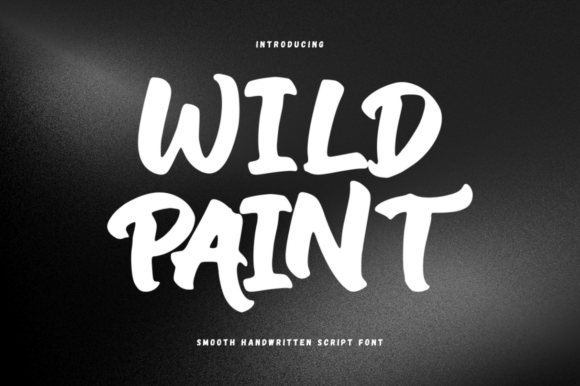
Wildpaint is a flowing, casual handwritten script—no stiff calligraphy rules, no forced formality. It’s the kind of typeface you’d imagine scribbled with a soft-tip marker by someone who loves rhythm over rigidity. Its curves are smooth but never uniform; its downstrokes have subtle swell, its upstrokes lift like a sigh. It’s not fussy, and it doesn’t try to be anything other than what it is: friendly, grounded, quietly confident. As a script font from the Script Amp collection, Wildpaint sits beautifully between playful and polished—ideal for makers who want authenticity without sacrificing clarity.
I first used Wildpaint on a set of greeting cards for a local florist—a bundle of “thank you” and “just because” notes printed on textured cotton paper. The font wrapped around short phrases like “you’re rooted in kindness” so naturally that the words seemed to bloom right off the page. Later, I tested it on matte-finish sticker sheets for planner lovers: tiny “breathe,” “done,” and “sip slowly” labels. Even at 8pt, Wildpaint held its charm—especially when I enabled the included stylistic alternates and ligatures for smoother connections between letters like “th” or “er.”
For physical products, Wildpaint shines where personality meets practicality. Candle labels? Yes—especially when paired with a clean sans serif (think Montserrat or Poppins) for ingredient lists or warnings. Wedding welcome boards or boutique gift tags? Absolutely. Its relaxed elegance avoids looking too bridal or too trendy—it simply feels human. I’ve also layered it into digital printables: printable wall art with seasonal quotes (“cozy season begins now”), planner cover pages, and even holiday mug designs previewed in mockups. Because Wildpaint renders cleanly at high resolution, it holds up beautifully both on screen and in print—whether you’re exporting for Etsy listing images or sending files to a local print shop.
That said, Wildpaint isn’t built for paragraphs. It’s a display font—meant for names, titles, short headlines, and decorative wording. On product tags or packaging, it works best for brand names or taglines (like “made with love” or “small batch, big heart”). For longer text—ingredient lists, care instructions, or story blurbs—I pair it with a simple serif (like Merriweather) or a neutral sans serif. This pairing creates visual hierarchy without competing energies: Wildpaint sings, and the supporting font listens.
When cutting with a Cricut or Silhouette, I always check the vector outlines before sending to the machine. Wildpaint includes well-hinted OTF and TTF files, and its open counters and generous spacing make it highly cut-friendly—even on delicate vinyl or thin kraft paper. For tiny stickers (under 1 inch), I avoid using swashes or extended flourishes unless they’re part of a deliberate design choice—sometimes simplicity reads clearer. And for mugs or tote bags, I export as high-res PNGs with transparent backgrounds to preserve those soft stroke edges during DTG or sublimation printing.
What makes Wildpaint especially useful for commercial crafters is its thoughtful design assets. Beyond standard uppercase and lowercase, it includes contextual alternates, discretionary ligatures, and swash capitals—all accessible via OpenType features in apps like Illustrator, Affinity Designer, or even newer versions of Canva. These details let you fine-tune tone: swap a basic “a” for a looping alternate to add whimsy to a birthday invitation, or activate a swash “Q” to anchor a farmhouse-style sign. And yes—it’s licensed for commercial use, including physical products, digital templates, SVG bundles, and merchandise. Just double-check your license covers your intended use (e.g., unlimited end products vs. limited runs), and verify multilingual support if you serve bilingual audiences—Wildpaint includes extended Latin characters, covering most Western European languages.
I’ve used Wildpaint across seasons: spring herb labels with hand-drawn illustrations, summer festival tote bag designs, autumnal printable wall art with “gather” and “grateful,” and winter holiday tags with “joyfully wrapped.” Each time, it adapts—not by changing its nature, but by letting the context shape how its warmth lands. It doesn’t shout. It leans in. And that’s rare in a world full of fonts trying too hard.
If you're choosing a script font for your handmade brand, ask yourself: does it reflect how you speak to your customers? Does it sit comfortably beside your product photography? Does it feel like something you’d write by hand on a thank-you note tucked inside a package? Wildpaint answers yes—to all three. It’s not just another script font. It’s the handwriting your shop has been waiting to wear.
- Perfect for candle labels, greeting cards, wedding stationery, and boutique packaging
- Works beautifully on stickers, mugs, tote bags, signs, and digital printables
- Pairs naturally with clean sans serifs or gentle serifs for balanced layouts
- Includes OpenType features—alternates, ligatures, swashes—for expressive control
- Licensed for commercial use across physical goods, templates, and digital downloads
Whether you're sketching ideas in a notebook or prepping final files for production, Wildpaint doesn’t ask you to chase perfection—it invites you to lean into presence. And in handmade work, that’s where the real magic lives.